
9 min read
Financial Advisor Trends: What 650 Advisors Said About AI, Digital Marketing, and Technology
Our Voice of the Advisor study shares these insights straight from financial advisors across the United States.
Key Takeaways
Seasoned and veteran advisors can learn from the new advisor’s holistic service, data-driven approach, and openness to AI.
As advisors gain experience, they tend to look for support outside the home office—the right technology partner is key.
How do you compare with your peers? What can you learn from more (or less) experienced advisors? In the 2023 Voice of the Advisor study, we surveyed 650 advisors evenly distributed across firm types, then broke down the data further based on their level of experience:
- New: 1–5 years
- Seasoned: 6–15 years
- Veteran: 16-plus years
Below are four opportunities we uncovered for new and veteran advisors who want to stay ahead of evolving industry trends.
Modern Client Expectations Drive a Focus on Goal-Based Financial Planning
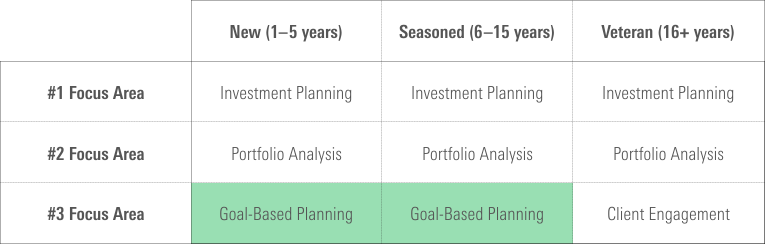
New and seasoned advisors are spending significantly more time than veteran advisors on goal-based financial planning—defined in our survey as a “strategic approach that focuses on helping clients identify and achieve their specific life goals.”
Not only do they invest their time in goal-based financial planning, but they are also striving to improve in that area. About 37% of new advisors and 39% of seasoned advisors indicated they’d like more help in goal-based financial planning.
Veteran advisors are the only group that doesn't include goal-based planning in their top three areas of focus.
Advisors who adopt goal-based financial planning are responding to a generational shift in mindset. From workplace culture to the proliferation of streaming services, today’s investors prioritize personalization and flexibility.
For example, newer investors often look for a flexible fee approach, instead of paying a commission or adopting an assets under management model.
Increasingly, newer investors treat advisors like doctors—they’re looking for a diagnosis of their financial goals, or a prescription for their financial concerns. Advisors who focus on goal-based planning may be able to attract younger clients who don’t necessarily have large portfolios, but are looking to pay for financial advice.
Beyond fee structures, goal-based financial planning is also useful for achieving personalization at every stage of the investor lifecycle. Whether a client is focused on accumulation, retirement, or drawdown, goal-based financial planning can help advisors drill into their priorities for that stage of life. Morningstar’s recent webinar on Unraveling Deeper Goals in Goals-Based Investing showcased that when they’re first asked about goals, clients focused on items like college, retirement, and buying a house—but when presented with more options, they revealed underlying desires such as vacations and experiences.
Depending on the client, drawdown/retirement may be about travel, leaving a legacy, philanthropic aspirations, or some combination of them all. Software can help facilitate efficient goal-based client conversations, determine the risk profile for each goal, and customize recommendations as needed to optimize for each goal. With the emergence of new technologies like AI influencing client communication, now could be the time for advisory firms to evaluate their tech stacks.
Marketing Is an Unappreciated Way to Gain a Competitive Advantage
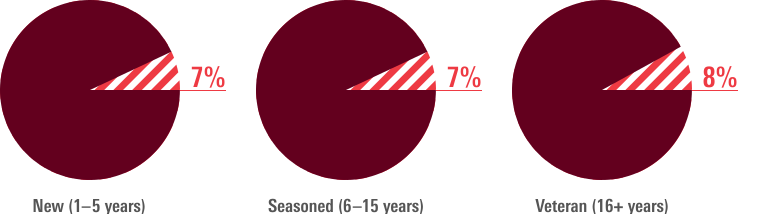
In our survey, advisors ranked marketing as one of the two areas where they’re spending the least time, even if they’re new to the business.
Advisors who are in their first five years are still building their book of business. As a result, their focus is developing relationships with prospects, and they lean heavily on the home office for portfolio strategy and due diligence. Despite this, new advisors indicate that they’re spending the least amount of time overall in marketing.
For some, it may be a budget issue, or perhaps they feel the marketing resources provided by their home office are sufficient. However, given the competitive landscape, advisors who are outsourcing their marketing efforts to the home office should invest in understanding whether the home office is meeting their needs.
Advisors indicate that marketing is one of the two areas where they’re spending the least time, even if they’re new to the business.
Regardless of experience level, advisors can gain traction by investing in marketing. We defined marketing as “various strategies and activities employed to promote services, build your brand, attract potential clients, as well as deepen relationships with existing clients through traditional or digital channels.” While this can include traditional activities such as networking and establishing relationships with centers of influence who provide referrals, these activities are time intensive.
Advisors can test what brings in new clients more efficiently by investing in digital or dollar-based marketing channels. They can also build their personal brand through an active social media presence.
According to Kitces’ Research Study On Advisor Marketing, advisors can look at client acquisition cost to measure the effectiveness of their marketing strategies. While activities such as COIs and networking are far more popular, from a CAC perspective, activities such as SEO and paid web listings are far more profitable.
Tactics and channels aside, successful marketing relies on understanding today’s investors—their preferences, needs, and trends. Advisors can educate themselves about evolving investor trends, then take advantage of digital marketing channels to efficiently reach future clients.
Seasoned and Veteran Advisors Can Learn From the New Advisors’ Openness to AI
As investor preferences and expectations change, seasoned and experienced advisors must adjust accordingly to keep pace, and to stay competitive during wealth transfers. Providing multiple services, demonstrating their data-driven approach, and adopting new technologies may help them increase their wallet share and attract new clients.
Our survey indicates that new advisors have several strengths. For example, they offer more services—including retirement planning, tax planning, and real estate planning—than seasoned and veteran advisors.
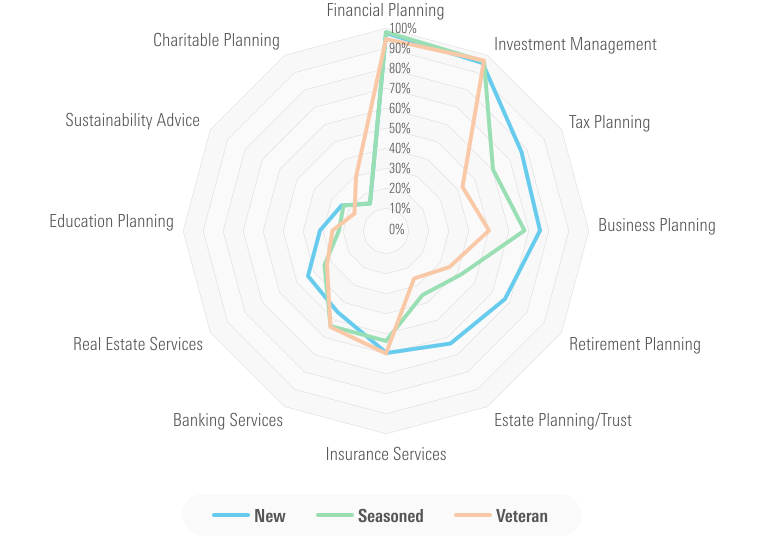
New advisors are also planning to continue increasing their services further, on par with the veterans in the business. Our survey also shows that client adoption is there, suggesting that the holistic services can be a competitive advantage.
New advisors also leverage more data-driven approaches to asset allocation compared to their more experienced peers. Our survey showed that they consider factors such as fundamental analysis and risk modeling significantly more than seasoned or veteran advisors.
When we interviewed 758 investors in 2022, respondents indicated that risk modeling can help attract investors who use online resources for advice instead of financial professionals. Advisors who integrate risk modeling capabilities into their practice may make significant headway in winning the trust of this group of potential clients.
Though artificial intelligence was not broadly used by the advisors in this study, new advisors used AI more often than their experienced counterparts. AI can boost productivity by reducing the time spent on lower-priority tasks. AI use cases for advisors include scaling client communications, crafting emails related to pressing topics, note-taking, and summarizing lengthy texts.
Surveyed advisors used tools like:
- ChatGPT
- BloombergGPT
- Finchat.io
- Morningstar's research assistant, Mo
- IndexGPT
As Advisors Gain Experience, They Look for Support Outside the Home Office—The Right Technology Partner Is Key
New advisors rely on the home office, but as advisors gain experience, they start looking for help elsewhere. Seasoned and veteran advisors are more likely to deviate from home office recommendations. But across the board, as advisors gain experience, they become interested in expanding to more specialized or tailored resources coming from asset managers, specialists, and software providers.
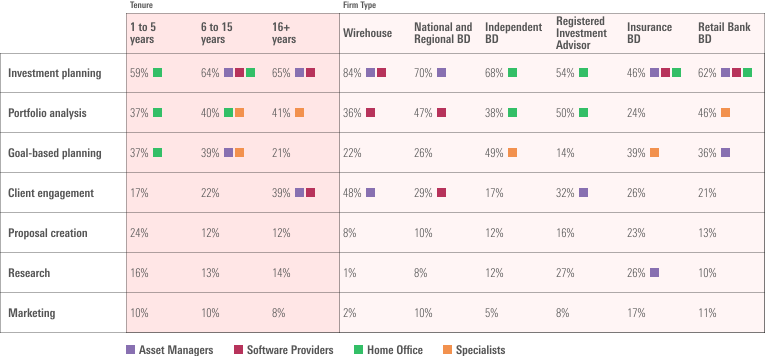
Veteran advisors have an existing book of business, so they’re often trying to get a larger wallet share from their clients. Some high-net-worth clients use multiple advisors and most tend to need more sophisticated portfolios, so the right technology partner can help advisors differentiate themselves from the competition. Software providers can give advisors the holistic view they need for better recommendations across asset classes and investment vehicles.
Another aspect to consider is generational wealth transfer. The turnover rate of advisors during generational wealth transfer is 70%. Adopting technology that supports personalization at scale can help veteran advisors retain clients and engage with prospects.
Advisors of all experience levels share the same goal: serving their clients. But financial innovation, digital connectivity, and market access are reshaping the landscape of investment opportunities and financial planning. Build a modern advisory practice with Morningstar’s insights and solutions for the Evolving Investor.